

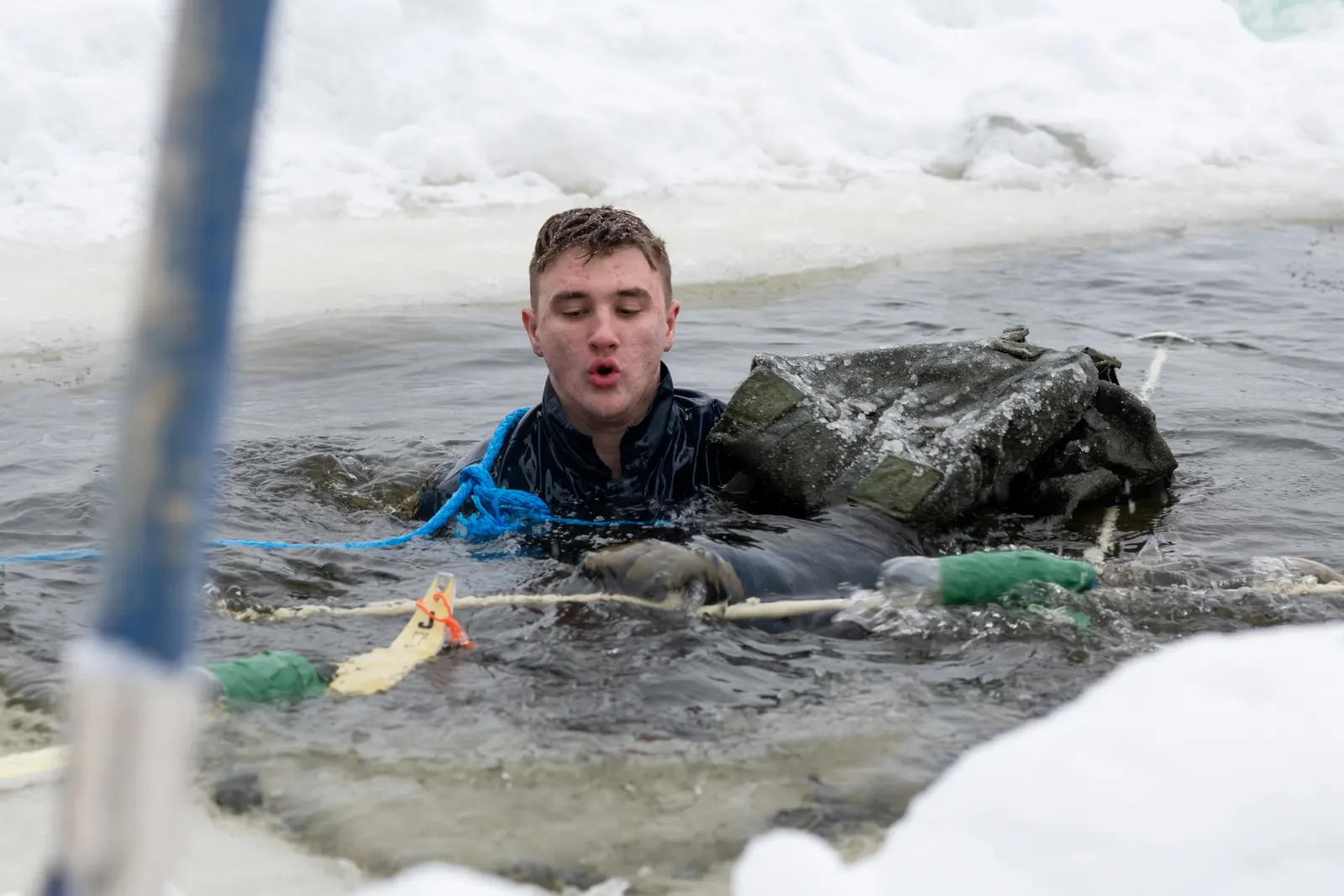
Finnish SERE preparation covers the path from losing support to returning: after abandoning an aircraft, aircrew must deal with injuries and cold; a soldier cut off from friendly forces must sustain themselves and evade the enemy. Capture changes the tasks to protecting information and limiting exploitation by captors. Return may involve moving back independently or being recovered. Finnish training therefore brings together survival, evasion, conduct in captivity and extraction.
After abandoning the aircraft
Finnish aircrew preparation starts with the consequences of escape from the aircraft. The pilot checks their condition, reviews the usable survival equipment, uses accessible first-aid supplies and establishes protection against the environment. Landing in water presents a different immediate task from landing in snow: in water, the person needs to reach their life raft as quickly as possible; on land, they need protection against further cooling. The Finnish cold-weather model treats the life raft, snow and personal equipment as possible means of protection. The actual landing site and the person's condition determine which can be used.
Personal signalling also requires action. With a manually activated PLB, the person must switch on the locator beacon themselves. Radios and signal lights serve different functions: they provide a connection or make the location recognizable to a searching force. Finnish preparation for an aviation emergency without an enemy threat also uses visibility and fire. The aim here is for search personnel to find the individual. Under an enemy threat, that same visibility can lead to capture; evasion and the prepared contact arrangements then determine when the person reveals their location.
Levels in the Finnish Air Force model
The FINAF model organizes preparation around the basic foundation and the risk of capture and exploitation. FINAF means the Finnish Air Force. In this model, the letters describe the following structure:
| Level | Place in the FINAF model |
|---|---|
| A | A basic foundation in SERE concepts, tasks and the military framework for conduct; introduced through instruction in early pilot training. |
| B | Academic and applied preparation for a moderate risk of capture and exploitation by an adversary. |
| C | Advanced academic and applied preparation for a high risk of capture and exploitation, addressing the threat and expected operational environment. |
Movement and a plan for separation
An older Finnish aircrew field model combines sustenance after abandoning an aircraft with subsequent evasion. First, parachute fabric, wood and wire are used to make a load carrier and weather protection. Group movement is followed by a solo evasion leg and another group leg. During the solo section, roads and large paths are avoided; the later resting site is concealed because search patrols remain active at night. The person therefore has to assess both their route and their halt. A path can simplify movement while concentrating the search on a line that is easy to monitor.
Equipment directly affects movement. Parachute fabric can provide load carriage and weather protection, but gains additional weight when wet. Its usefulness must be weighed against the load the person can still carry. This older field model uses material available to aircrew after an emergency; the Finnish brigade approach likewise calls for using the personal means actually available.
In the Jaeger Brigade's Finnish B field model, participants prepare for separation from friendly forces with a mission-specific evasion plan. It specifies the rendezvous, when to stop waiting there and how to proceed if the group remains incomplete. After separation, the person moves to the agreed point and waits for other members as planned. If some are still missing when the wait ends, those present follow the prearranged plan. The next action therefore does not have to be agreed over a radio with the missing members. When to stop waiting is decided during planning, according to the situation.
Winter isolation: movement, sustenance and exhaustion
A Finnish winter-SERE field phase combines evasion with movement on military skis, personal equipment carried in backpacks and pulks, temporary protection and obtaining supplies. A pulk is a towed load sled. It takes the load off the back, but moving it still requires pulling effort. In deep, soft snow, skis enable progress where movement on foot is not possible. The effort of covering the route and transporting the load has to be supported by a limited amount of food.
Drinking water is produced by melting snow. This requires time, a container and heat. Food obtained from the surroundings also requires work. In the Finnish B example, fishing is abandoned because opening the thick ice would consume more energy than the expected food would provide. The practical comparison is therefore: what will obtaining this resource provide, and how much strength will it cost before the next leg must be covered? Carried supplies retain their value when a possible food source requires substantial effort.
Limited sleep and food affect successive movement and rest phases. In the Finnish winter field setting, some soldiers were already struggling to stay awake during a quiet activity. In evasion, this particularly affects observation while stationary. Personal pacing must therefore also account for a usable, sheltered opportunity to rest. Organized recovery with sleep, food and drink reduces the effects of strain, but does not immediately restore every aspect of performance. For an isolated person, a pause depends on available protection, warmth and the threat; indoor accommodation and meals cannot be assumed from such a training model.
Captivity and information protection
The Finnish brigade concept prepares personnel for questioning and exploitation by an adversary; the Air Force includes Conduct After Capture in SERE. A specific Finnish elementary framework for prisoners of war limits disclosure to name, rank, date of birth and identification-tag number. The prescribed answer to other questions is: “En voi vastata kysymykseen” — “I cannot answer the question.”
This distinction separates identifying the person from providing militarily useful information. When asked about their unit's location, missions or other personnel, a person who explains their reasons may already disclose the information being sought. Refusing to answer should therefore not turn into an explanation of the mission. Here, resistance means giving the required identity details without adding information about friendly forces.
The legal framework for prisoners of war prohibits coercion to obtain information. The SERE task also addresses a captor applying pressure: protect information, limit exploitation and, when the situation permits, support escape and return. After escape, sustenance, the adversary's search and contact with friendly forces again become the individual's own tasks. The Finnish extraction objective therefore also includes the person's contribution to their own or assisted return.
Location, recognition and physical recovery
The Jaeger Brigade addresses contact for recovery with and without communications equipment. The Finnish soldier's basic contact model provides a concrete sequence for returning to a friendly position: approach the guard or contact point from the ordered direction, give the agreed approach signal and follow the guard's instructions. The signal and direction must have been known before separation. The receiving guard must actually be present and know the agreement.
A prepared rendezvous determines the individual's movement decision; the agreed approach enables recognition by the receiving force. A location signal initially answers where to search. Physical recovery follows when friendly forces can establish contact and take the person into their care. In an aviation emergency, a functioning signalling device, reception of its signal and available search and recovery forces must come together. Until then, the aircrew member must continue to deal with injuries, the environment and, where present, the enemy threat.
C preparation and winter SERE in the brigade model
The Finnish brigade instructor pathway combines a C phase with a separate winter-SERE phase. Its theoretical preparation and practical tasks address survival and movement in enemy-controlled territory, conduct after capture, the personnel recovery concept, and using personal equipment and the surroundings. The brigade approach works with the means that the respective personnel would also have available in an actual emergency.
The appearance of U.S. Department of War (DoW) visual information does not imply or constitute DoW endorsement.