

Norwegian SERE preparation addresses the loss of communications, supplies and freedom of movement in very different situations. An aircrew member may land in snow after ejecting with only a small survival kit; a reconnaissance patrol has to survive far behind enemy lines and return without being detected. Cold connects these tasks: people who cannot organise shelter, water and movement with the resources they have lose the physical ability to keep evading or reach a recovery point. Preparation for captivity adds a situation in which other people control movement and supplies.
Different training programmes address these tasks. The NATO Winter Survival Course prepares aircrew for survival after losing an aircraft. SERE also forms part of Norwegian field reconnaissance training. The NATO Cold Weather Survival Instructor Course develops the ability to sustain a longer stay with minimal equipment in enemy-occupied terrain. Conduct After Capture, or CAC, covers resistance to interrogation and hostage survival. In Norwegian training descriptions, the final E often stands for Extraction: recovery from the isolation situation.
Aircrew: retaining the ability to act with a small survival kit
The NATO Winter Survival Course is for Norwegian and allied aircrew, including student pilots and navigators. Initial instruction covers clothing, emergency shelter, a heat source, sustainment, living in snow and cold injuries. During the subsequent field phase, participants put this knowledge into practice. They move through snow, establish a sheltered resting place, obtain water and food, and make their location recognisable. The practical task starts with the equipment actually remaining after an ejection or forced landing.
Practised substitutes include snowshoes made from branches and parachute cord, and weather protection made from a parachute or a Fjellduk protective sheet. Snowshoes spread the load over a larger area; sinking less deeply reduces the amount of snow to be overcome with each step. A slipping binding interrupts this effect and needs adjustment. When resting, a sheet over the body is insufficient on its own: contact with the cold ground also has to be reduced by an insulating layer.
A shelter site and a signalling area serve different purposes. Woodland provides protection from wind and access to fuel; a nearby open area allows an orange parachute panel or an available smoke generator to be used. The equipment is prepared for use at the required moment. With enemy observation, the same visible signal can disclose the location. The actual contact situation then determines when the person leaves concealment and which agreed marking they display.
Cold: shelter must continue to work while waiting
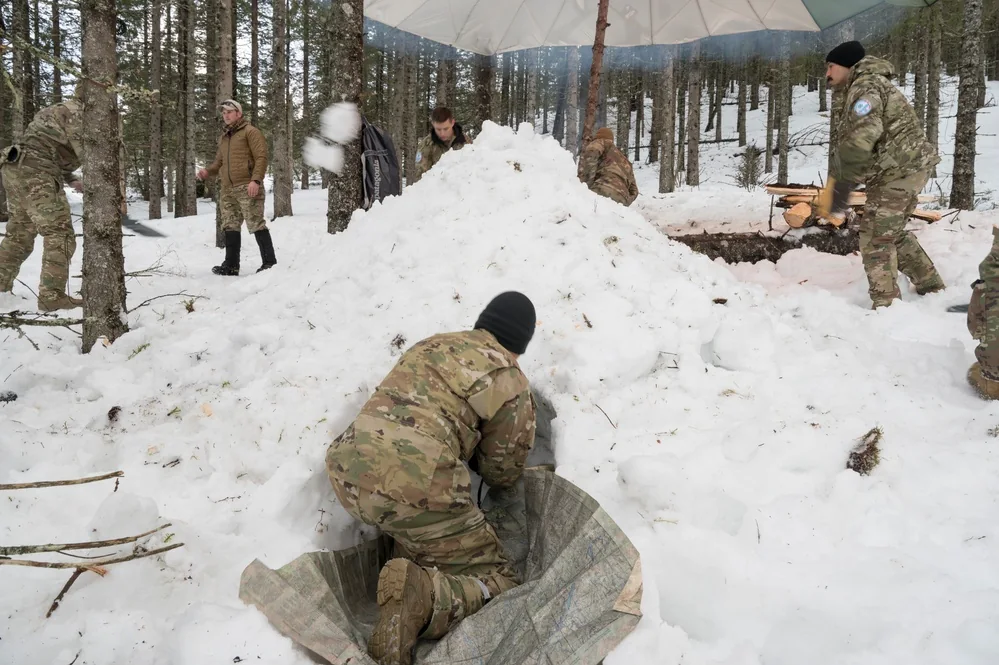
A snow bivouac can keep out wind but requires monitoring. Norwegian field procedures explicitly address accumulating snow, a subsiding roof and a clear ventilation opening. A shovel remains accessible inside. An isolated person needs to check whether the entrance remains usable after snowfall and recognise changes before the shelter becomes an obstacle. In a small group, monitoring and rest can alternate. Someone alone has to allow for the necessary periods awake when planning their rest.
Cooking and heating introduce another hazard. Combustion gases must not enter the occupied interior of a snow shelter. The cooking position therefore needs adequate ventilation and a location from which warm air and exhaust do not enter the sleeping area. A heat source also does not replace roof checks: warming and additional snow load change the shelter. An unsuitable bivouac requires another site before exhaustion or a blocked exit makes movement harder.
Along the route, the shape of the snow-covered terrain matters more than distance alone. Norwegian winter procedures distinguish an avalanche starting zone from the runout below it. A seemingly flat route can therefore be exposed if a relevant slope lies above it. Route assessment has to consider both areas together. Without a reliable local avalanche assessment during isolation, a concealed or short line cannot be treated as passable on that basis alone; an alternative route also has to lie outside the potential avalanche path.
Isolated patrols: combining sustainment with a concealed return
Norwegian Feltoperatører work in small, concealed reconnaissance patrols, often far from friendly forces and without support from other units. Their training combines SERE with winter fieldcraft, medical skills and communications. In Telemark Battalion, SERE also prepares patrol soldiers to survive behind enemy lines, avoid discovery and reach safety without external support. There, winter survival is practised at times with the patrol remaining together; the autumn module places more emphasis on evasion under complete isolation.
A concealed return requires a different choice of location from a stay in which someone waits visibly for search forces. Before necessary movement, the next stretch and recognisable human activity are observed from concealment. Sounds may indicate vehicles or people before they become visible. Only the assessed stretch is then crossed; further observation takes place from another protected position. Vegetation and terrain features can interrupt direct lines of sight. Movement across an open crest, by contrast, places the body against the background.
A resting site has to permit sustainment and observation without trapping the person. Approaches should be observable, while a way out is needed if someone comes closer. Rattling equipment is secured and unnecessary movement avoided. Snow makes the travelled line visible. Grabbing snow-covered branches can also leave revealing changes. Careful movement reduces additional signs, while route choice still depends on enemy activity and the person's physical capacity.
Water and heat are part of the movement decision. Travelling far for fuel or water consumes strength and leaves additional tracks. Melting snow requires heat energy. A sheltered stay close to resources that can actually be used may shorten these trips, but a fire produces light and smoke. If discovery is a risk there, the person must assess whether the available protective equipment is sufficient or whether they need to change location or shorten their stay. Someone who remains concealed for a long time without adequate cold protection may become too cold or exhausted to move on.
Instructor training for prolonged cold-weather survival
The NATO Cold Weather Survival Instructor Course is aimed primarily at officers and NCOs destined for long-range reconnaissance and special operations. Its subject is prolonged survival behind enemy lines using minimal equipment and local resources. Tasks include making individual shelters from a sheet or poncho, longer-term bivouacs for small groups, and sustainment activities such as fishing and recognising and preparing suitable food. These activities have to preserve the ability to act when normal supply lines are absent.
The stay includes woodland and terrain above the tree line. In woodland, vegetation and available timber can make shelter and warmth easier to obtain. Above the tree line, immediate access to wood disappears; wind has a greater effect on an unprotected body and a poorly secured shelter. Before changing location, the person therefore has to assess which materials can be carried and whether the new site provides enough protection. A short route across exposed terrain may consume more warmth, food and strength than a longer sheltered line.
Local sustainment also takes effort. A fishing location is useful only with suitable equipment and enough time; unfamiliar plants are not a dependable meal. Gathering, obtaining and processing resources have to be weighed against cold exposure, movement and discovery. Existing rations remain a resource that can be planned around, while the possible yield from the surroundings has to be assessed on site. Instructors teach individuals and small groups how to account for these demands when obtaining supplies and moving.
Captivity: identity, information protection and survival
Norwegian CAC preparation covers resistance to interrogation and hostage survival. This addresses both the extraction of military information and dependence on a captor. In controlled scenarios, instructors play the captors; participants experience their reactions to losing control and facing stressful situations. National delivery is restricted to certified CAC instructors and authorised exercise directors under the responsible Air Force authority.
For Norwegian personnel as prisoners of war, the duty to provide identity information covers first and last names, rank, date of birth and service number. In this context, the Norwegian service number is the fødselsnummer, the personal identity number. There is no obligation to provide further information; physical or psychological coercion to obtain it is prohibited. A prisoner therefore needs to distinguish personal identity details from questions about the mission, forces or capabilities. Establishing identity does not require an account of military activities.
This prisoner-of-war framework applies to international armed conflict. The additional hostage preparation addresses capture by non-state actors and the resulting combination of survival and interrogation pressure. An escape attempt also requires consideration of the specific actions involved. Under prisoner-of-war law, an unsuccessful attempt is generally subject to disciplinary treatment; violence against people can additionally lead to criminal prosecution. An opportunity to get away from the guards therefore has to be assessed together with the consequences of the chosen approach.
Recovery: aligning one's own route with possible contact
Within the NATO framework, possible recovery is prepared before a mission. An Evasion Plan of Action sets out the intended conduct and movement if isolation occurs. Identity and authentication information allows recovery forces to verify a contact. For the person, this preparation means knowing intended locations or contact areas, signalling equipment and communication arrangements. If a change of location becomes necessary, these intentions are compared with the actual threat, terrain and personal condition.
An available survival radio is useful only with power, a viable transmission path and a reachable counterpart. If contact succeeds, location, condition and relevant hazards are passed in a form that allows forces to assess an approach. The person prepares agreed visible signs and protects authentication information. If contact fails, shelter needs, the observed threat and the prepared evasion intention determine the next decision to rest or move. Preserved strength and organised survival equipment keep later recovery or an independent return possible.
During a possible recovery, location and identity are separate tasks. A marking can show where someone is; authentication checks who is there. The approach therefore follows agreed procedures and instructions actually received from the recovery forces. Which forces can arrive, and whether a particular site can be reached, also depend on weather, terrain and the enemy. Shelter, observation and signalling equipment have to work together so that the person can respond to contact without unnecessarily disclosing their location beforehand.
The appearance of U.S. Department of War (DoW) visual information does not imply or constitute DoW endorsement.