

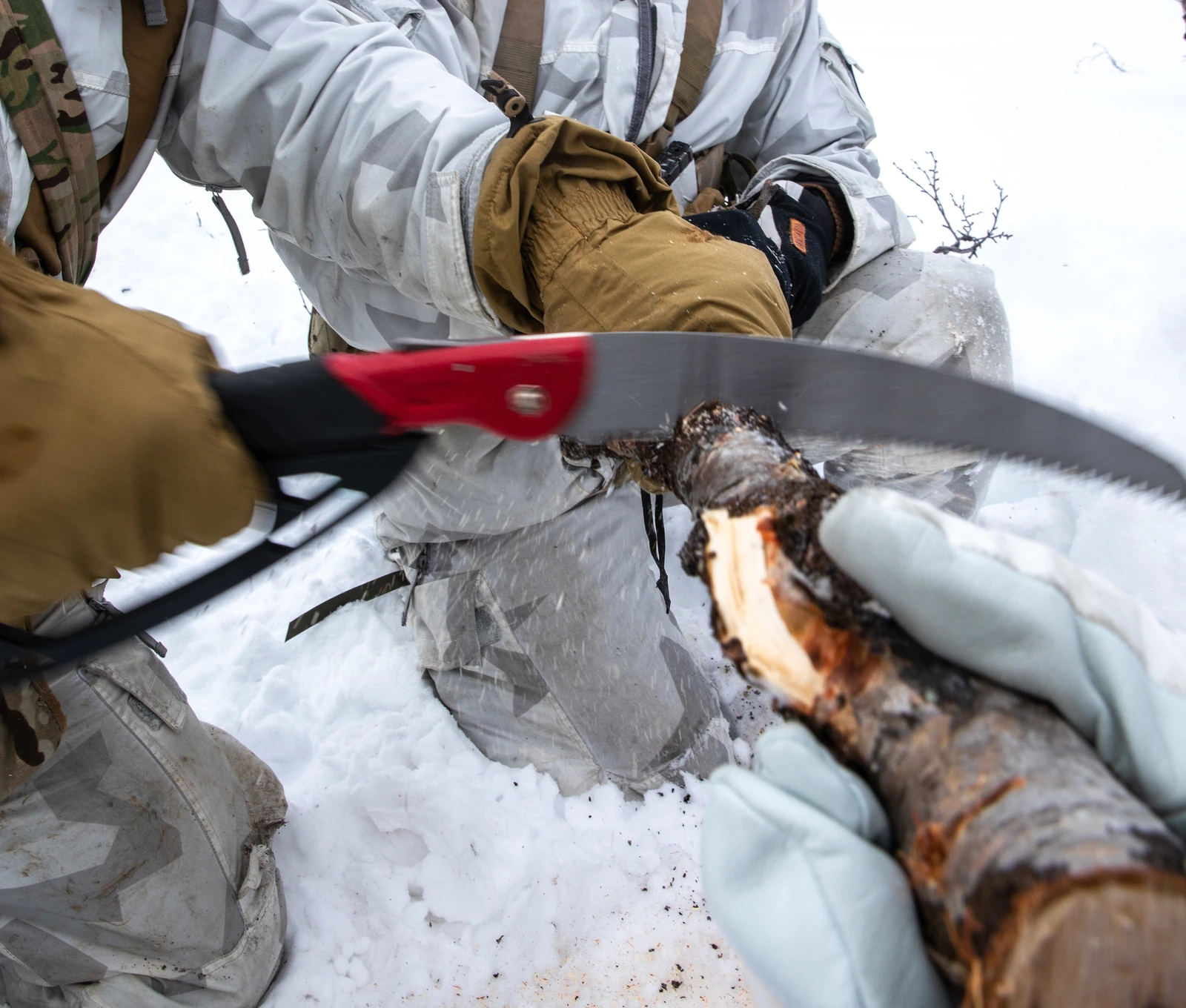
Swedish SERE training connects survival with concealed movement, conduct in captivity and preparation for recovery. An isolated person has to balance shelter and sustainment against the risk of discovery: they decide whether they can remain at the incident site, need a hiding place or must move on. For aircrew, the practical SERE A Flyg course runs from a simulated aircraft incident through sustainment with limited resources to movement on foot and recovery.
Training for isolation and recovery
Försvarsmaktens överlevnadsskola, or FÖS, is the joint armed forces survival school based at K 3 in Karlsborg. Its remit covers Survival, Evasion, Resistance and Extraction, together with Personnel Recovery. Extraction here concerns the recovery or pickup of isolated personnel. The school trains personnel from different parts of the armed forces; many are preparing for an overseas assignment or a state of readiness. Appropriate SERE training forms part of preparation for the particular isolation risk.
The isolated person's tasks include protection, movement, protecting information and participation in pickup. On the armed forces side, staffs and units need to be able to plan and conduct recovery. The two sides can meet when the person can be located and forces are actually available. Until then, they must manage injuries, water, rest and movement with the means they have. These tasks of the forces and the isolated person interact in Personnel Recovery.
SERE A Flyg is part of Swedish aircrew training for pilots and other flying personnel, such as navigators. The described practical programme is delivered by Människan i flygsystemet, MIFS, a department at Luftstridsskolan. The A in its name identifies this national course: it includes field tasks, equipment use, sustainment, navigation and signalling. Participants work with the equipment themselves and carry out tasks in the field. Captivity exercises address another loss of control: the person is detained and has to keep making decisions under a captor's power.
SERE A Flyg: from an incident to self-sustainment
The starting point is a simulated crash or emergency landing. Aircrew members must then remain capable of acting outside their aircraft. The practical sequence begins with a night in a tent, after which equipment is progressively reduced and replaced by bivouacs made from natural materials. Less food and sleep make subsequent tasks harder. The final task is a march on foot to a designated endpoint followed by recovery.
The reduction in equipment changes concrete decisions. A tent does some of the work of protecting the participant from the weather; with fewer resources, they must reassess the rest site, available insulation and workload. A fire can provide warmth but also produces light and smoke. Under threat, an existing sheltered location requiring less work may therefore be preferable to extensive, conspicuous construction. Equipment withdrawn during a supervised course is a resource to retain and use in a real incident.
Sustainment subjects include water treatment, identifying edible and inedible plants, hunting and fishing. For the isolated person, this creates a resource problem: searching for food costs time and energy, and without suitable means or reliable identification it does not provide a dependable return. They have to weigh that effort against the next movement and the stay in a hiding place. The aircrew model's emergency equipment is intended to bridge a limited period; delayed pickup may make additional sustainment necessary.
Pace counting and GPS navigation with and without interference complement one another. Pace counting estimates distance travelled along a chosen direction when electronic positioning fails. The person must account for both their direction of travel and the distance covered. Slopes, soft ground and fatigue change stride length, so a pace count alone does not replace a check against the terrain. The person must prevent an uncertain position estimate from corrupting both their route and a later location report.
Hiding places, observation and concealed movement
Following an isolation event, the vehicle is a suitable place to remain only when the security situation permits it. If the person must leave, they take their emergency equipment to a protected hiding place. Necessary movement is guided by the prepared route or a designated recovery area. Available communications are used according to the practised procedure. A transmission may be received even when no reply is heard; the person nevertheless does not base subsequent sustainment and movement on an unconfirmed pickup.
At the hole-up site, they combine sustainment with preparation. They improve concealment, determine their position, inventory their remaining equipment and attend to injuries and water. They then check the prepared route, the recovery procedure and the information intended for identity verification. They decide when and where they can move and how they will leave if discovered. Where the situation allows, they observe the potential pickup or landing site from there. They do not have to wait exposed at the site simply to detect an approaching force.
The Swedish conduct framework uses SOLO for concealed movement: Stanna, Observera, Lyssna, Ofta — stop, observe, listen, often. The person moves in short stages between cover and concealment. At each halt, they scan the terrain and listen for sounds obscured by their own movement. These repeated observation periods give them an opportunity to detect a danger before the next exposed stretch, instead of continuing unchecked in the same direction.
Before moving, they adapt their camouflage to the terrain. Low light and poor weather can reduce visual exposure while also making navigation and observation harder. A predictable line along a ridge or through a valley makes the next direction easier to anticipate. People, domestic animals and unnecessary tracks also increase the chance of discovery. Before crossing a road, the person observes the area and seeks a stretch with limited visibility. A bend or dip is a possible terrain feature for that purpose, but must be assessed alongside traffic movement and actual observation opportunities.
Waiting and moving remain competing options. A protected evasion hiding place can allow rest and sustainment, while moving again increases the risk of discovery. If the hiding place is discovered or the planned route becomes unusable, they need an exit considered in advance. Aircrew training also addresses the situation in which recovery is delayed or moved to another location. That changes the route, the supplies required and the time to signal.
Captivity: exploitation, escalation and personal control
The Swedish conduct framework for captivity begins with assessing how the captors actually behave. Two connected problems are at stake: exploitation of the person and escalation leading to severe violence or death. For prisoners of war, the duty to provide information is limited to surname and first names, rank, date of birth and a personal or registration number, or equivalent information. This does not create an additional duty to give military information. The obligation concerns prisoners of war and cannot be transferred as a general rule to every civilian hostage situation.
With captors acting unlawfully, the person must consider the risk of escalation in their response. The Swedish approach calls this kontrollerat givande av information, controlled provision of information, and explicitly takes account of protecting defence and foreign-affairs secrets. The person must judge how to avoid an immediately life-threatening escalation while limiting exploitation. An opponent's violation of a prisoner's rights does not remove that prisoner's protection under international humanitarian law.
Even when captors control their movements, the person is expected to preserve dignity and self-respect and retain as much control over their thoughts and reactions as possible. They continue to assess events around them and which decisions affect their chance of survival. Escape is planned but attempted only when there is a realistic chance of success. The first step out of confinement must therefore be considered together with the subsequent route, sustainment and renewed risk of discovery.
In training, deprivation of liberty involving restraints or a blindfold is treated as a Resistance exercise. It belongs in controlled training under SERE instructors, with a regulated opportunity to stop and protection against physical or psychological injury. Swedish provisions distinguish Resistance exercises for A and B from C; delivery of the C element is assigned to K 3 and FÖS. Conduct under a captor's control is addressed in a separately regulated setting.
Signals, identity verification and pickup
Swedish aircrew training includes radios, lamps and other distress signals, in both concealed and more conspicuous forms. The person has to relate their use to the threat: a visible marker can guide friendly forces to the location while also attracting an opponent's attention. In the link-up procedure, signalling equipment is therefore prepared in the hiding place so it can be used promptly at the appropriate contact. The person remains concealed until identifying friendly forces; coordinated contact then provides the reason to become deliberately identifiable.
Before contact, the person keeps equipment organised, prepares an available radio and identity verification, and gets ready to move from the hole-up site to the pick-up point. Personal information intended for verification, for example in an ISOPREP, serves a different purpose from the signal: the force needs to establish whom it is facing. A location marker alone cannot answer that question. A change of pickup site likewise requires reassessment of the route out of hiding.
If radio contact with an actually arriving recovery force is impossible, the Swedish link-up model calls for agreed PR signals after the friendly force has been positively identified. The person then follows its instructions, adopts a non-threatening posture, holsters their weapon and is ready to verify their identity. These steps reduce the risk that an armed person appearing unexpectedly will be perceived as an additional threat. Until pickup occurs, cover, observation and personal sustainment remain the person's tasks.
Winter changes sustainment and the risk of discovery
In northern Sweden, long distances and limited infrastructure meet snow, cold and distinctive light conditions. For an isolated aircrew member, this changes the distance they can cover and the time for which they must sustain themselves. Training in the Lapland mountains is also planned for the described aircrew programme. National winter training separately develops the ability of personnel and units to work in subarctic conditions. The isolated person must adapt sustainment and movement to snow, darkness and cold.
Under hostile threat, winter also presents a signature problem. Tracks in snow can reveal the route to a resting place. Heated shelters stand out more strongly against a cold background; in freezing, still conditions, smoke can linger above a location. The person must therefore weigh the need for warmth against visibility, thermal signature and the tracks left by movement. Matching clothing colour to the snow does not prevent tracks, smoke or thermal imaging from revealing the person.
When selecting a rest site, they consequently assess existing weather protection, possible observation from the terrain and the effort needed to move later. Every additional trip between the rest site, a water source and the pickup point can create new tracks and consume energy. If a fire becomes necessary for warmth, light and smoke add to the person's signature.
The appearance of U.S. Department of War (DoW) visual information does not imply or constitute DoW endorsement.