

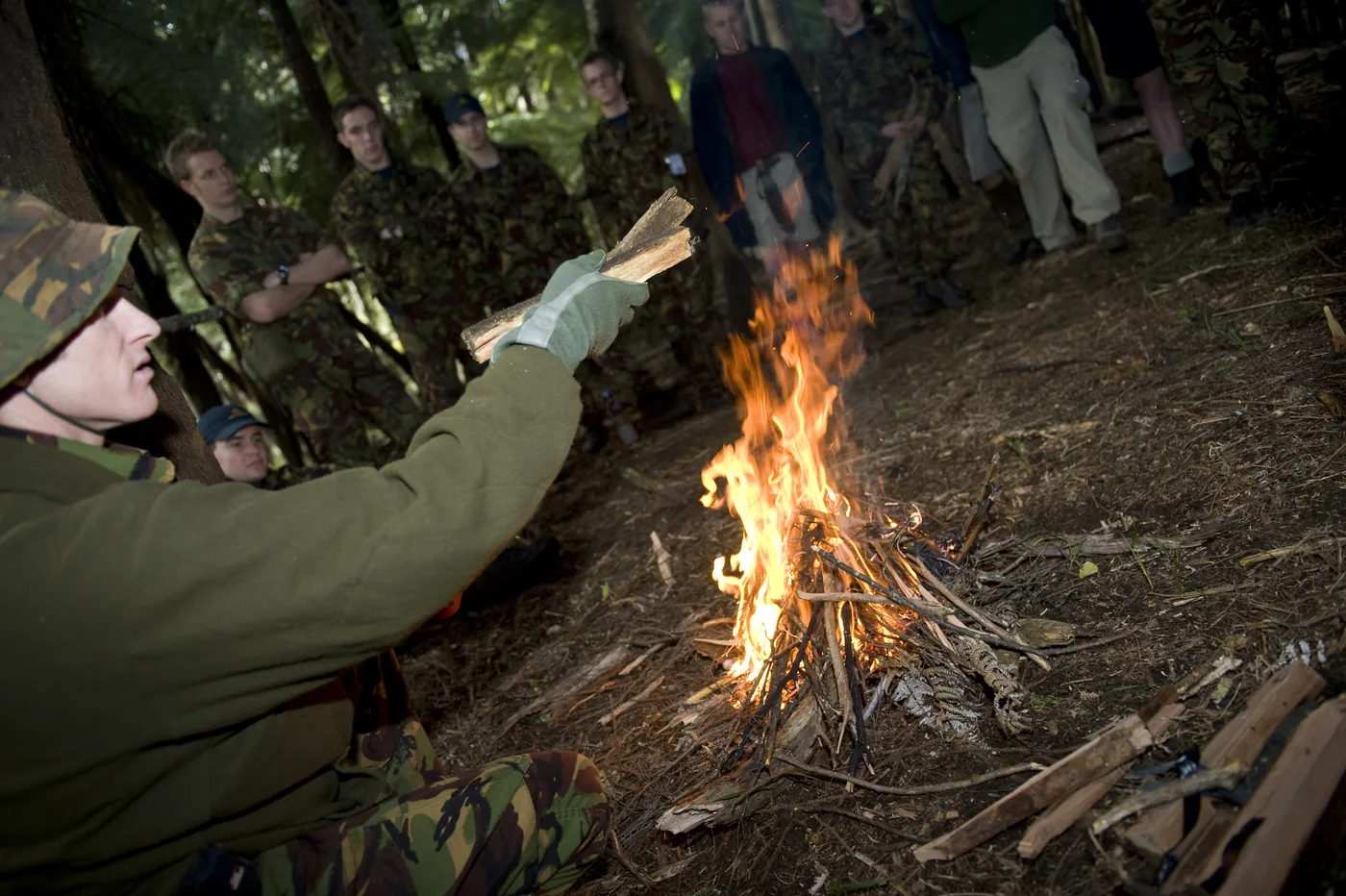
New Zealand SERE training – Survival, Evasion, Resistance and Escape – connects preparation for an emergency with conduct during military isolation: staying alive, evading an adversary, surviving captivity and returning to friendly forces. Aircrew training environments include bush, coast and sea. One New Zealand Special Air Service (NZSAS) pathway moves from survival procedures through a patrol movement under pursuit to Conduct After Capture. Cold-weather preparation for selected roles and the use of survival equipment actually carried add further tasks.
Aircrew survival: from the emergency to sustaining yourself
For Royal New Zealand Air Force (RNZAF) pilots, survival training precedes flying training. Theory and practice cover bush, coastal and sea survival. Parachute instruction and aviation medicine form separate parts of the wider preparation package. In the Flight Steward pathway, a two-week SERE component sits within the Combined Non-Commissioned Officer Aircrew Course; Aviation Medicine and further general aircrew training are separate components. Helicopter Loadmasters also undertake practical sea and bush training and subsequently maintain skills including underwater escape, first aid and rescue techniques.
The role-related training of Seasprite aircrew shows the individual tasks this creates. Each participant must operate a single-person life raft and configure it as a shelter. With the multi-person raft, the tasks include operating it, collecting the survival aids, boarding and assembling its roof. The assembled roof provides a covered shelter for the occupants.
Other tasks include rendezvousing with fellow survivors and using a Personal Locator Beacon to report the location. A functioning, activated beacon and reception of its alert are required for the search organisation to use the transmitted information for locating. Aircrew must continue protecting themselves until an actual pickup.
NZSAS: applying survival procedures under pursuit
In the NZSAS pathway, SERE Mod-A teaches survival techniques and procedures. These include cold-weather survival, weather prediction and an introduction to river crossings. Mod-B provides the following evasion task: patrols move through designated rendezvous points while a hunter force tracks their movements or attempts to block routes. They meet scenario role players at those points. After completing this task, they enter a Conduct After Capture component. Mod-A and Mod-B are modules in this pathway, rather than national equivalents of international SERE Levels A and B.
A passage blocked by the hunter force may compel a detour to the rendezvous point. A longer route costs time and strength and prolongs exposure to the cold. Weather developments and the participants' condition affect whether another leg can be completed. An unprotected rest site prolongs cold exposure, while an injured person may limit the pace of the entire patrol.
Cold-weather protection is deliberately limited in this evasion task; survival skills taught earlier are intended to make up part of the shortfall. Boots that are too tight can impair circulation. Unsuitable socks and freezing conditions add to the risk of frostbite and consequent loss of walking ability. With personal footwear, fit with the socks actually worn therefore matters alongside its designation as a cold-weather boot. A patrol has to account for physical injury in its further movement before it becomes disabling.
Conduct After Capture: protecting information and fellow captives
Conduct After Capture is a tri-service New Zealand Defence Force (NZDF) capability for personnel exposed to capture, questioning or adversary exploitation during deployment. A captive shows their identity card on demand and gives their name, rank, date of birth and service number. They need not give further information and are to resist attempts to obtain it to the best of their ability for as long as possible. This separates establishing identity from disclosing additional information.
Oral or written statements harmful to New Zealand and its allies are prohibited. Captives must not promise to refrain from escape or a return to hostilities in exchange for concessions. Such a promise would allow the adversary to free guards for other duties. Captive NZDF personnel have a duty to attempt to escape and rejoin the NZDF.
Within a captive group, NZDF personnel remain subject to their discipline and the orders of their superior officers. They must not harm fellow prisoners for favourable treatment or aid the adversary. If a guard claims that New Zealand has agreed to deprive its captives of their rights, the claim is to be treated as a trick.
Captivity in an international armed conflict and hostage-taking require different assessments. Prisoners of war are entitled to the corresponding status and protections. Humane-treatment rights remain in other capture situations. A hostage-taking group has already violated the law by taking hostages; its behaviour cannot be presumed to follow the regulated administration of a prisoner-of-war camp. The duty not to harm fellow hostages for preferential treatment still applies. The NZDF may issue specific conduct orders for this situation.
Cold-weather preparation: building shelter, obtaining water and moving
Cold-weather training supplements isolation preparation for RNZAF aircrew and selected other NZDF personnel. Crews carrying a Personal Survival Pack for the relevant duties first work with its contents. Tasks include erecting the Minaret tent, adding a windbreak of snow blocks, then making snow shelters such as caves or trenches. Participants spend the night in them.
Participants use a cooker to melt snow, boil the resulting water and prepare rations. They also practise stable slope movement, using kicked steps or steps cut with an ice axe, and arresting a fall. When selecting a route through avalanche terrain, they assess snowpack stability and loading, slope angle and weather. Glaciers and crevasses create further movement hazards. A short route to water or shelter may consequently introduce a greater danger than a longer route through suitable terrain.
Signalling and supplies during isolation
An aircrew refresher connects the use of PRC-112G survival radios with a supply task: participants are to use transmitted coordinates to find an airdropped load of food and first-aid equipment among trees. This requires a serviceable device, reception of the message and a load available on the ground. Participants operate the device, use the location information and find the load. Such supplies support the person during isolation; the subsequent pickup requires suitable forces and transport means to be available.
Cold-weather training employs location aids for three tasks: attracting attention, holding it and directing searchers to the precise location. A conspicuous marker may indicate a search area while the person's exact position within the terrain still needs to be identified. Under adversary threat, the same visibility creates a detection risk. The person has to assess whom the signal may reach and which forces can actually enable a pickup. The article on Personnel Recovery explains how locating, support and recovery work together within an operation.