Approaching the narrow mountain terrace, Jeff Peterson lost sight of the ground. The rotors of his HH-60G Pave Hawk had stirred up dust; beside the pickup point, the mountainside dropped steeply away. His flight engineer and gunner had to tell him which way the aircraft was drifting. Marcus Luttrell and Mohammad Gulab were waiting below. Before either man could be flown out, the crew had to keep the helicopter within this confined space.
Four days earlier, on 28 June 2005, Luttrell's reconnaissance team had been attacked in the mountains of Afghanistan's Kunar Province. Michael Murphy, Danny Dietz and Matthew Axelson had been killed. A helicopter bringing reinforcements had been shot down with sixteen men aboard. Wounded, Luttrell had moved away from the battle. The American search force could now retrieve him alive partly because Afghan villagers had fed him, hidden him and protected him from the armed group.
A reconnaissance mission in Kunar
Operation Red Wings was part of American efforts to suppress armed groups in eastern Afghanistan before the parliamentary election in September 2005. Important routes in Kunar ran through remote valleys close to the Pakistani border. American units could not simply control one continuous area. They operated among scattered settlements, wooded slopes and high ridgelines, while local fighters knew the surroundings and had contacts in the villages.
The 2nd Battalion, 3rd Marines had prepared Red Wings against Ahmad Shah's group. Shah was a local militia leader aligned with the Taliban. His men attacked American and Afghan forces. The Marines intended to locate the group and disrupt its activities in the area.
The plan had several phases. A small team would first observe and identify the wanted men. Only then would larger forces conduct the assault and establish a cordon. The Marines would subsequently remain in the area, patrolling and maintaining a longer presence. Before any assault, success therefore depended on the reconnaissance team remaining concealed and passing on what it found.
The Marines had originally planned to use six scout snipers, approaching their observation positions on foot. For the later air movement in low light, they requested helicopters from the 160th Special Operations Aviation Regiment. That support came with a change in responsibility for the first two phases: special operations forces took over reconnaissance and the assault. The Marines remained responsible for the cordon and the subsequent presence in the area.
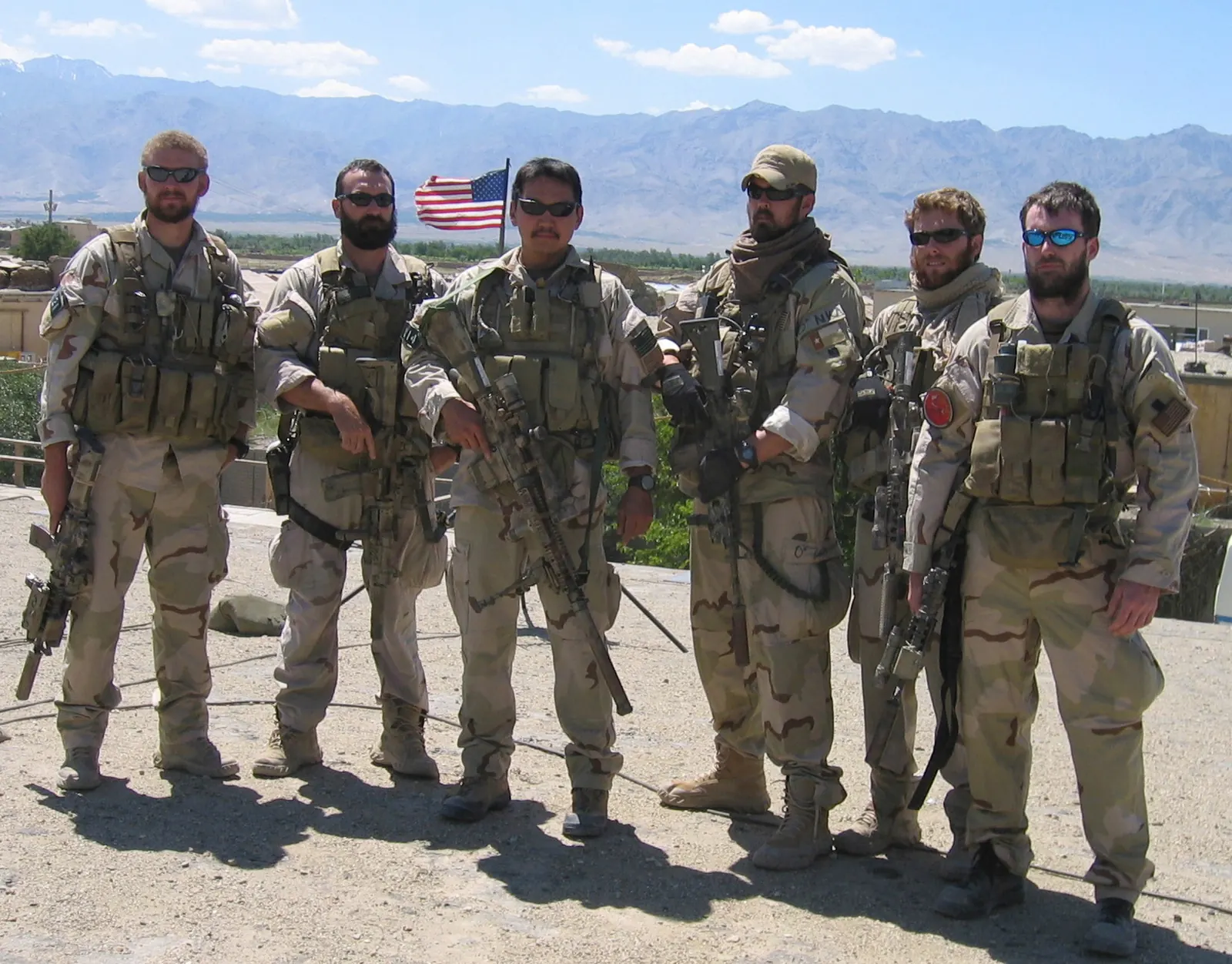
The reconnaissance team actually deployed consisted of four Navy SEALs led by Lieutenant Michael Murphy. Dietz handled communications. Axelson and Luttrell completed the team; Luttrell was also a trained medic. They carried weapons, observation equipment and communications devices. On the night of 27–28 June, a helicopter inserted them on Sawtalo Sar, a mountain between the Korangal and Shuryek valleys.
Discovery on the mountainside
Late on the morning of 28 June, the Americans encountered unarmed local people with goats. People from the area now knew where they were. The SEALs let them go. The reconnaissance team could no longer assume its presence remained unnoticed. Later that day, Shah’s group attacked from more favourable positions above them.
The terrain made the attack more severe. The SEALs had to move under fire on steep slopes while their opponents fired rifles, machine guns and rocket-propelled grenades from higher positions. A rock or fold in the ground might protect a man from one direction without shielding him from another firing position. As the team descended, its members lost elevation and visibility; wounds made movement harder still.
Murphy's call for help
The team carried a handheld radio and a satellite telephone. Ridges and steep gullies restricted radio communication while the men changed position under fire. The satellite telephone also needed a sufficiently clear view of the sky and repeatedly lost its connection in the deeply folded mountainside.
The subsequent citation for Murphy’s Medal of Honor describes the team leader trying to summon help after the primary communicator was mortally wounded. He left cover to find a better transmitting position, passed his location and requested immediate support. Doing so exposed him to enemy fire. Murphy was mortally wounded during the engagement.
Dietz and Axelson did not survive the engagement either. Luttrell became separated from the others and moved out of the immediate battle area. He was wounded and exhausted, but could still move. As he continued through the mountains, he sought water and tried to evade his pursuers.
The loss of the quick reaction force
A quick reaction force was assembled while the team fought on the ground. An MH-47 Chinook of the 160th Special Operations Aviation Regiment carried eight additional SEALs and eight Army aviation personnel towards the area. They were to land near the battle and assist the four-man reconnaissance team.
During its approach to the mountain, the aircraft was struck by a rocket-propelled grenade and crashed. All 16 men aboard died. They included SEAL officer Erik Kristensen, who had flown with the reinforcements. Together with Murphy, Dietz and Axelson, 19 American servicemen were killed on 28 June.
The crash also changed the search. Besides finding the four reconnaissance personnel, the force had to determine whether anyone had survived the helicopter loss. Troops needed to reach the crash area, recover the dead and look for the missing team. While aircraft searched above them, American and Afghan soldiers moved into the valleys.
Mohammad Gulab and the villagers
Luttrell moved away from the battle area and looked for water. His encounter with local people did not begin with mutual trust. Shortly after the events, Gulab said the wounded American had pointed his weapon at him. He had raised his thumb and lifted his tunic to show that he was not concealing a weapon. The villagers eventually helped Luttrell to a settlement in the Salar Ban area. They provided water, food and Afghan clothing. Mohammad Gulab played an important part in protecting him.
Gulab discussed taking him in with other villagers. They considered Luttrell their guest and invoked traditional Pashtun obligations of protection. When the fighters demanded his surrender, the villagers refused. After the threats, they moved him out of the house and hid him in a stable overnight.
While the helpers cared for Luttrell and protected him, one villager set off for an American base carrying a written message from the American. The note reported his whereabouts and established a connection between the helpers in the village and the search force. Luttrell also stated in the note that its bearer had given him food and protection and should himself be helped.
From uncertain radio signals to a confirmed pickup
The rescue crews had meanwhile searched for possible survivors without knowing their exact location. Jeffrey Macrander recalled radio noise that might have been a survivor trying to respond, or an attempt by the enemy to lure another aircraft into the area. The helicopter crews called to the missing men but could not make a pickup. Despite these indications, they had to end the search when fuel and increasing daylight limited their stay.
Following the message from the village, soldiers reached Luttrell. Two rescue helicopters were assigned to fly him out, with armed aircraft and helicopters supporting the pickup. Gulab remained with the wounded man during the preparations.
The pickup was carried out by Air Force HH-60G Pave Hawks. These helicopters were intended for recovery from hostile territory and carried pararescuemen who could retrieve people and provide medical care. The two aircraft belonged to the Air Force Reserve rescue forces deployed to Afghanistan. Jeffrey Macrander led the flight; Jeff Peterson piloted the helicopter that collected Luttrell.
The two aircraft flew from Jalalabad through the valleys into the mountains. During the approach, the forces on the ground changed the reported landing point. The crews therefore had to adjust to a different location shortly before the pickup. Low cloud hampered visibility over the target area, while higher cloud obscured the faint starlight. The pickup point was a narrow terrace beside a steep drop. A-10 attack aircraft and other armed aircraft supported the approach, while Army special operations troops were already on the ground.
The intended airborne marking initially failed too: cloud prevented infrared illumination from a higher-flying AC-130 from reaching the ground. An A-10 eventually marked the site so Peterson could identify it. Macrander added a further marker at the pickup point and remained above the area while Peterson descended towards the terrace.
Shortly before touchdown, the rotor stirred up dust that obscured Peterson's view of the ground. In this brownout, he could no longer judge clearances and the aircraft's position from the cockpit alone. His flight engineer and gunner therefore called out the helicopter's position and gave directional guidance. The crew stabilised the aircraft at the confined pickup point until Peterson could set it down on the terrace. Macrander provided top cover in the second helicopter.
Pararescuemen Josh Appel and Chris Piercecchi went out to make the pickup. Luttrell and Gulab wore Afghan clothing. In the darkness and dust, appearance alone did not identify the men approaching the helicopter. Piercecchi checked Luttrell’s identity with personal questions before taking him aboard. Both men were helped into the helicopter and flown to Asadabad. From there, a C-130 transported Luttrell to the hospital at Bagram Air Base. On 2 July, the search for the living member of the reconnaissance team was over.
The dead and the helpers
Recovery of the dead took longer. Troops continued to search for the fallen SEALs and recovered the victims of the helicopter crash. For their units and families, Red Wings did not end with Luttrell's rescue. Murphy was posthumously awarded the Medal of Honor in 2007; it was presented to his parents on 22 October.
For Gulab and his family, providing sanctuary remained dangerous. They had to leave their village, and threats against him continued for years. In January 2015, Gulab left Afghanistan for India. Later that year, he was able to resettle with his family in the United States. Ten years separated his taking in the wounded American and his own permanent departure.
The appearance of U.S. Department of War (DoW) visual information does not imply or constitute DoW endorsement.