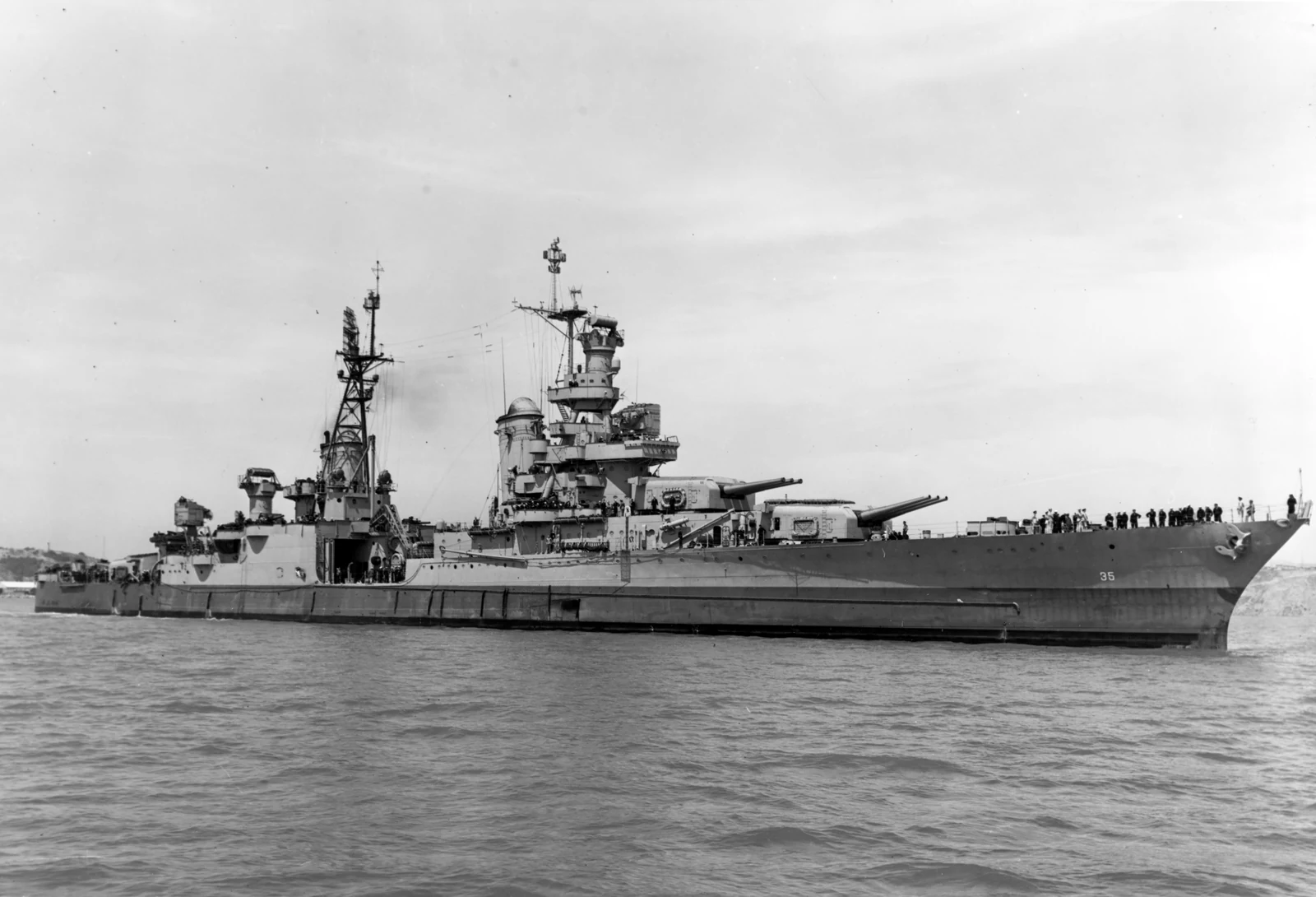
On 28 July 1945, the American heavy cruiser USS Indianapolis left Guam for Leyte in the Philippines. Captain Charles B. McVay III was taking his ship to join a training group. The crew had recently returned from repairs in California and completed a transport mission to Tinian at short notice. They were now scheduled for ten days of exercises before the cruiser resumed fleet operations. Many of the men had joined during the repair period. McVay needed to familiarize them with their ship and work them into a crew alongside the experienced hands.
The repairs followed a bomb hit off Okinawa. On 31 March, a Japanese bomb had passed through the hull and exploded beneath the ship, although Indianapolis remained afloat. After leaving the yard, she received a secret assignment: carrying components of the atomic bomb Little Boy to Tinian. The cargo was unloaded on 26 July. By the time McVay sailed from Guam two days later, that mission was complete. The Navy authorities responsible for the next passage had been notified of his destination and expected arrival at Leyte.
The passage from Guam to Leyte
The routing instructions sent Indianapolis along Route Peddie at an average speed of advance of 15.7 knots, with arrival expected on 31 July. Guam’s departure message went to the port authorities at Tacloban, which handled arrivals for Leyte, and to the training group, among other recipients. The information needed to follow the passage was therefore available: the identity of the ship, her destination and the date she was due.
At sea, the cruiser had no antisubmarine escort and no sonar of her own with which to locate a submerged submarine. The authorities responsible for the route regarded it as relatively low risk. Indianapolis’s intelligence briefing did include submarine reports, but several contacts were old or uncertain. Her written instructions left zigzagging to the captain’s discretion. These changes of course were intended to make a submarine’s torpedo solution more difficult. McVay discontinued them after dark.
During the night of 29–30 July, the Japanese submarine I-58, commanded by Mochitsura Hashimoto, reached an attacking position. How clearly the cruiser could be seen that night became a disputed issue afterwards. McVay described periods of darkness with an obscured moon; other witnesses recalled good visibility at times in moonlight. Whatever the changes in conditions, Hashimoto could see and track the ship sufficiently at the crucial moment. From her starboard side, he fired a spread of six conventional torpedoes. The manned Kaiten torpedoes also carried aboard I-58 were not used in this attack.
Hashimoto mistook his target for a battleship and subsequently reported sinking one. His account of the hits also differs from the American reconstruction. Two torpedo hits are accepted for Indianapolis, both in the forward part of the ship: one near the bow, the other in an area containing essential command and communications facilities. The damage therefore compromised both the cruiser’s ability to stay afloat and the crew’s ability to assess what had happened and respond to it.
The cruiser sinks in twelve to fifteen minutes
Shortly after midnight, the explosions woke McVay in his bunk. Fire and smoke spread forward as water entered the hull. The bridge soon lacked a dependable picture of the damage. Electrical power and telephone circuits had failed, and the electric engine order telegraph could no longer reliably carry commands to the engine rooms. The cruiser continued moving while her bow settled deeper. Pressure in the fire main was lost as well, depriving the men fighting the fires of an essential part of the ship’s damage control arrangements.
At first, Indianapolis had only a slight list. McVay had experienced severe damage off Okinawa followed by the ship remaining afloat, but this time the situation deteriorated rapidly. The damage control officer reported her condition, followed by the executive officer. When the order to abandon ship was given, it had to travel by word of mouth. Below decks, smoke, flames and blocked routes consumed part of the few minutes remaining. As the deck tilted farther, wounded men and loose equipment slid towards the low side, and even uninjured men struggled to reach the open air.
The ship’s doctor, Lewis Haynes, was trying to fit life jackets to badly burned patients when men and equipment slid down the sloping deck. McVay left the bridge to investigate the radio messages but never reached the radio room. Eventually his route took him across the rising port side. Men jumped or climbed into the sea; others were swept overboard. After roughly twelve to fifteen minutes, Indianapolis capsized to starboard and sank by the bow. Those still alive had only the equipment they had carried off the ship or could reach in the water.
During this short interval, radiomen had tried to call for assistance. In Radio Room One, Joseph Moran keyed a message giving the torpedo hits, the ship’s position and the need for immediate help. The transmitter was in another compartment, however, controlled through cables passing through burning and flooded areas. Moran could not tell whether his signals were reaching it. An SOS was also attempted on 500 kilohertz from Radio Room Two. The subsequent investigation found no confirmed reception of these distress messages. None of the documented transmission attempts led to a rescue order.
What each group could reach
Hundreds of men entered the sea alive, but no one could count them all. The cruiser’s continued movement had already separated men as they abandoned her. In darkness, the groups could not see one another, and badly wounded men died early. McVay and Haynes later gave different estimates; Haynes thought there had been seven or eight hundred in the water. An exact figure cannot be recovered from these recollections. In the first hours, the more immediate question was whether a man could find other survivors and something to keep him afloat.
The ship had carried buoyant rafts, floater nets, inflatable life belts and kapok-filled jackets. Much of this equipment went down with her. Some came free on one side of the capsizing hull while men entered the water on the other. It was therefore distributed very unevenly. McVay reached a small raft party. Moran eventually found himself with nineteen other men, four rafts and a floater net. Haynes, meanwhile, was among a much larger group which initially had neither rafts nor its own supplies.
Daylight on the first morning revealed the differences between these groups. Moran and his companions could keep their stores together and spend some time out of the water. When one raft rode too low, they placed the floater net beneath it for support. Although three water casks were empty, the party had adequate water and provisions overall. Elsewhere, men collected drifting containers and lashed several rafts and nets together. Each such arrangement made it easier to support casualties without another swimmer having to carry them continuously.
The larger raft party around the engineering officer Richard Redmayne also had several flotation aids but had to ration its food severely. On Tuesday, 31 July, each man received one cracker. On Wednesday, the allowance was another cracker and a malted milk tablet. Water containers could be empty, leaking or filled with brackish water. A raft offered better opportunities for rest and assistance without necessarily providing enough to drink. Nor could one party simply pass its supplies to less fortunate men: the groups were separated by distances across which no one had an overall view.
Haynes estimated his group at three to four hundred on the morning of 30 July. Most remained immersed. Men without jackets held onto those worn by others. To support the wounded, helpers reached through the backs of their life jackets and rested their bodies against a hip, keeping their mouths and noses clear of the water. This required constant effort. Each wave shifted bodies against one another; clothing and jackets rubbed the skin raw. A man supporting a casualty could not rest while doing so.
Wind and current carried the groups farther apart. Wind acted on the rafts standing higher above the surface, while swimmers drifted differently. McVay’s party moved farther north and for a long time knew nothing of Haynes and the men around him. Even at a short distance, waves could hide heads and low flotation aids from view. There was no common command over all the survivors and no supply point they could all reach. Assistance depended on the men who had actually remained together.
Helping one another through thirst and exhaustion
Many had swum through oil during the sinking. It entered their eyes, noses and mouths; Haynes described burning eyes and vomiting. Daylight brought the glare of the sea as well. Men tore clothing into strips and tied them across their eyes. This relieved one problem but offered no shelter from the sun. Without rafts, the swimmers could neither leave the water during the day nor find a dry resting place at night. Even in this warm sea, prolonged immersion drew heat from exhausted bodies. During the nights, the men suffered severe chills.
Haynes tried to arrange the swimmers so that the weakest would not drift away at the edges. The sick and wounded were placed in the centre. Men passed their arms through their neighbours’ jackets and sometimes tied themselves together with the straps. A drifting life ring with a long line offered another point of support. When a man died, his jacket was used for someone still alive. The doctor had lost both his medical equipment and his treatment space. Much of what remained possible was organizing help, supporting bodies and heads, and preventing men from abandoning the little assistance available.
As time passed, even brief sleep became dangerous. A life jacket could keep a body near the surface without keeping the face clear if the head fell forwards. Shipmates had to watch and support one another. Those doing so were also exhausted, thirsty and suffering from damaged skin. Severe burns and other injuries further limited how long a man could hold on or help someone else. The group provided assistance, but each death and each passing hour left fewer capable men to do the work.
For those without supplies, thirst became the dominant problem. Haynes tried to stop men drinking the clear seawater. Its salt content made it unsuitable for drinking; it could not replace the fresh water they were losing. The doctor described diarrhoea, worsening dehydration and profound confusion after men drank it. Injuries, sunshine, night-time chilling and lack of sleep also contributed to their deterioration. Haynes himself experienced hallucinations. He could not always trust his own perceptions while trying to reassure the others.
Some men claimed that the ship was still just beneath them and that fresh drinks were available aboard. Others followed, swimming away from the group or diving towards the supposed supplies. These shared delusions were recorded in interviews shortly after the rescue. Their consequences were immediate: men left the support of their companions and spent their strength on a journey offering neither water nor shelter. Those who swam after them to help became exhausted too. The Marine officer Edward Parke and the chaplain Thomas Conway repeatedly assisted other men. Both died after their own strength had been spent.
Sharks added to these dangers. Bite wounds and mutilated bodies were recorded, and men often could not tell what was touching them in darkness. The number killed by shark attacks nevertheless cannot be established reliably. During his own roughly 110 hours in the sea, Haynes did not see an attack on a living man; rescue pilots later saw sharks feeding on bodies. With badly decomposed remains, it was often impossible to determine whether an injury had occurred before or after death. Wounds, lack of water, exhaustion and drowning were already killing many of the survivors.
Why the missed arrival produced no search
While these groups drifted at sea, Indianapolis failed to arrive at Leyte on 31 July. No search followed. Port authorities had applied a rule prohibiting arrival reports for combatant ships to reports of their failure to arrive as well. The rule was intended to reduce radio traffic and preserve security. In practice, its interpretation left no effective check to turn an overdue ship into a reason for further action. The announced cruiser remained in the working records without her absence being investigated in time.
The training group did not initiate a search either. It had received the departure message but had not fully decoded garbled orders about arranging training for Indianapolis. The formation went to sea for its own exercises, expecting to find the cruiser on its return. Port authorities and the training group thus held parts of the same passage information without arranging a timely check. The later investigation identified defective procedures and failures by individuals responsible for them. The atomic bomb cargo, already unloaded at Tinian, does not explain this breakdown.
The men in the water knew nothing of these failures. They saw aircraft and tried to attract attention with flares, mirrors, yellow cloth and, where available, dye in the sea. From normal reconnaissance altitudes, however, small rafts in inconspicuous colours and individual heads were hard to detect. Oil on skin and clothing further reduced their contrast against the water. The survivors could not know whether an aircrew had even noticed their signals. None of these early encounters brought assistance.
On Thursday, 2 August, Wilbur Gwinn flew over the area in a Ventura patrol bomber. He was on a routine reconnaissance flight, not looking for Indianapolis. An oil slick suggested a damaged enemy ship. As he descended and followed it, he recognized people in the water at about 1120 local time. At first, he estimated thirty men. Further groups showed him that there were considerably more. Some slapped the surface with their hands to make themselves visible.
Gwinn transmitted a position report, dropped a raft and a sonobuoy, and remained overhead. Initially, he did not know which ship the men had come from. Further sightings enlarged the area, and the first position, estimated in haste, needed correction. Other aircraft and ships could now be sent directly to the survivors. More than three days had passed since the sinking. Some men were already so weak that discovery followed by another long wait would not be enough.
Adrian Marks lands among the swimmers
George Atteberry, Gwinn’s squadron commander, took off in a second Ventura, while Adrian Marks flew out in a PBY Catalina flying boat. At the American base on Peleliu, reports were relayed by telephone and available forces dispatched while written radio messages were still moving through normal channels. Two Army B-17s, there on another flight, and an R4D transport were loaded with rescue equipment. They carried inflatable rafts, jackets and an airborne lifeboat. Atteberry directed the drops from overhead, including towards groups away from the initial sighting.
Atteberry asked Marks to hold off dropping rescue equipment and first guided him around the whole area. The Catalina carried a limited supply. Had Marks dropped it all to the first men he saw, others would have been left without assistance. Eventually he distributed his own crew’s emergency equipment too, keeping only one raft. Yet isolated swimmers were already unable to reach the rafts being dropped. The first ship was not expected until around midnight. Marks therefore decided to land on the sea and take men aboard before it arrived.
The Catalina touched down at about 1700 in a heavy swell. Marks described waves around twelve feet high, a little over three and a half metres, and three hard bounces during the landing. Rivets loosened and seams opened. Crew members pushed pencils into holes, stuffed cotton into leaks and bailed water from the radio compartment. They kept the damaged aircraft afloat while beginning to recover men. Atteberry could see the swimmers more easily from his Ventura and guide Marks towards men disappearing from view between the waves.
Even with an aircraft beside them, many could not get out of the sea unaided. A ladder hung over the Catalina’s side, and a crew member caught men drifting past. Burns and broken limbs complicated every lift; some men no longer had the strength to maintain a grip. The engines had to be stopped and restarted repeatedly. If the aircraft taxied too fast, it dragged men holding onto a raft thrown to them through the water. Once aboard, they received drinking water and the limited first aid the crew could provide.
When the interior was full, more men were placed on the wings and covered with parachutes. Eventually, over fifty found shelter in or on the Catalina. The damage and load prevented a safe takeoff. Marks had to remain on the water until a ship could take them off. His decision had lifted the men out of the sea, but it also made the aircrew dependent on the ships reaching them.
During the evening, Richard Alcorn landed another amphibious Catalina on the sea. The U.S. Army operated this aircraft as the OA-10A. His crew, too, had seen men unable to reach the rafts dropped to them. They recovered one isolated survivor. Darkness made further movement among the debris too dangerous. Two crew members tried to reach other men calling for help by taking out an inflatable raft, but the heavy swell restricted them to the length of the line connecting it to the aircraft. The plane’s lights later helped guide ships towards the men. Unlike Marks, Alcorn was able to take off again the next morning.
Recovery and transport to hospital
The destroyer escort Cecil J. Doyle, commanded by Graham Claytor, was the first ship to reach the area. During the approach, Claytor ordered a searchlight pointed into the sky. It gave the aircrews a reference point and allowed the men in the water to see the ship coming. The light also exposed the destroyer escort to any enemy submarine nearby. When another rescue ship subsequently reported an underwater contact, the lights were briefly extinguished. The contact was later assessed as probably not a submarine.
Around midnight on the night of 2–3 August, Doyle reached the aircraft on the water and lowered her motor whaleboat. A doctor and first aid personnel accompanied the trips. They had to move the survivors from the Catalina into the boat and then onto the rolling destroyer escort. Many needed stretchers; others needed help simply to stand. Meanwhile, Doyle searched for more men with her lights and beneath flares dropped by the aircraft. A whistle led the rescuers to a raft they could easily have missed in the dark.
Other ships and their boats spread across the area. Aircrews passed new positions as the survivors and wreckage continued drifting. The ships had to manoeuvre carefully to avoid running men down. At each transfer, the boat and ship moved against one another while the exhausted survivors could do little to help themselves. The fast transport Bassett initially used her most experienced boat crews until others had to relieve them. Lifting men damaged antennas and radio sets in the small boats, making further trips harder to coordinate with their parent ship. An attempt to hoist a fully occupied boat to the rail was abandoned because of difficulties with the lifting arrangements.
On the morning of 3 August, a doctor transferred from Madison to Bassett. He remained because of the patients’ condition as the transport carried them to Fleet Hospital 114 at Samar. Doyle and other transports took their wounded to Base Hospital 20 on Peleliu. Farther north, McVay and the drifting raft parties were also found on 3 August. The last living survivors were brought aboard that day. The search continued afterwards, but increasingly found bodies, empty rafts and debris.
At Peleliu, the port authorities, operations watch and medical staff had to coordinate the hospital reception before the ships arrived. Twelve ambulances were arranged for Doyle, with 102 stretchers ready at the beach. Small landing craft were to move the patients from ship to shore, and the available oxygen facilities were prepared for the incoming casualties. Doyle’s ninety-three patients reached the hospital early on 4 August. No death was recorded during that transfer.
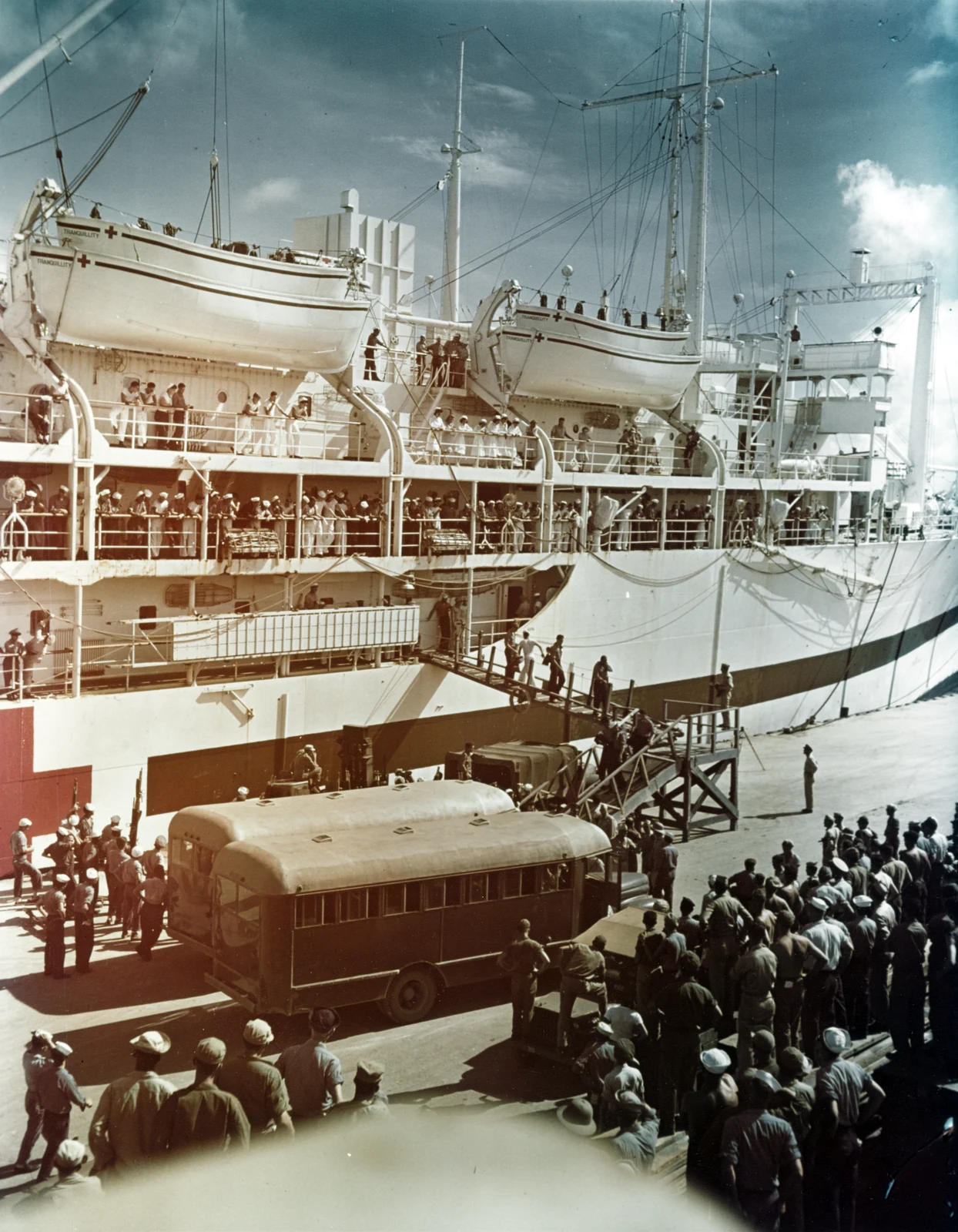
Four men nevertheless died after being recovered alive. Two did not survive Bassett’s passage to hospital. At Peleliu, Fred Harrison and Robert Shipman died on 5 August. Of the 320 men initially brought out of the sea alive, 316 also survived the period after rescue. Many still needed treatment. The hospital ship Tranquility left Peleliu on 6 August with 166 patients, eighty on stretchers and eighty-six able to walk. One further survivor remained on the island for treatment. On 8 August, Tranquility reached Guam, where her patients were brought ashore.
The final loss figures are 1,195 people aboard and 879 dead. The long-used totals of 1,196 and 880 included Clarence Donnor, who had left Indianapolis in California before departure to attend different training. He was not on the final voyage. Initially listed as missing, he was mistakenly reclassified as a survivor after his mother reported that he was alive. This also produced the subsequently circulated figure of 317 survivors. Correcting his entry changes the number aboard and the number dead, but not the 316 men who survived the sinking and the period after rescue.
Investigations followed the disaster. Clearer procedures were required for reporting failures to arrive, alongside calls for more visible rafts, waterproof first aid equipment and more dependable emergency supplies. McVay’s decision over zigzagging became the subject of a separate court-martial. The survivors had by then received care at Samar and Peleliu, and some had been moved on to Guam. As they were subsequently brought together, many learned only then which of their shipmates had also lived through the days at sea.
The appearance of U.S. Department of War (DoW) visual information does not imply or constitute DoW endorsement.